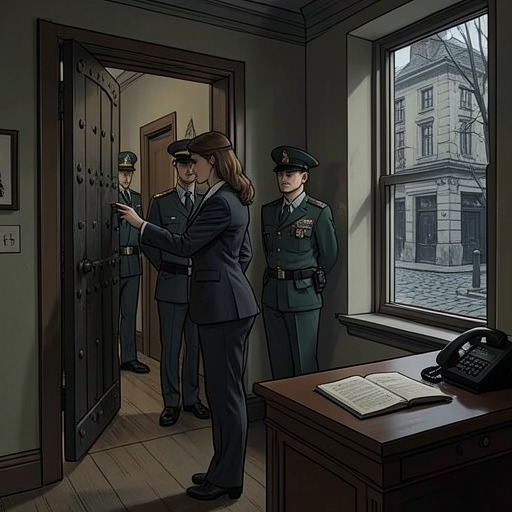
Carly Whittle
Blow OutCarly Whittle is a detective constable whose investigative work makes her one of the practical anchors of Jo Stuart’s inquiry into the ricin-pellet attacks. She is trusted with sensitive duties, contributes questions that test the evidence, and ultimately places herself between a suspect and a colleague to protect Henry Mwamba. Her arc brings the novel’s procedural discipline into contact with its human stakes: close attention to evidence can guide an investigation, but it cannot make its consequences painless.
Identity and Introduction
Carly first appears within the police workplace, where Gordon Holmes passes her desk while following Ged. The brief introduction places her among the investigation team before the narrative begins to show the scope of her responsibilities. She is addressed as both Carly and Detective Constable Whittle, establishing her rank and her role as an operational officer rather than a remote adviser.
As Jo’s investigation gathers pace, Carly is included in the flow of information and fieldwork. Jo asks the team to hear updates together, insisting that every member should have access to the same information and that any mind might spot a missing connection. Carly’s recurring presence in briefings, interviews, searches, and scene work gives concrete form to that shared-investigation approach.
Investigative Work and Judgment
Carly’s competence is especially visible in the procedural details. When she handles a set of laminated sheets, she identifies them as a handy digest of the Murder Investigation Manual. The sheets contain checklists and diagrams covering the key elements of investigative strategy, material a review team must consider after the Fast Track menu. Nick Carter remarks that the person who kept the manual close had seemed unusually capable after DCI Caton left; Carly’s familiarity with the guide places her inside a culture in which method and practical knowledge matter.
Jo entrusts Carly with the care of a body at the mortuary, leaving it in her hands while the other investigators and the pathologist are expected. The assignment signals confidence in her reliability and her ability to preserve the integrity of a sensitive investigative process. Elsewhere, she takes notes when Jo questions Heather Rand about her movements and whether anyone might hold a grudge against her. Carly’s work is not merely clerical: accurate records help turn an interview into material the inquiry can assess.
At a search, Carly sits beside Jo with a tablet, pocketbook, and biro, equipped to record findings in more than one form. Jo tells the team not to touch anything they discover and to call her over instead. Carly’s place beside her and the instruction’s emphasis on restraint capture the discipline required at a scene: a useful discovery must also remain usable evidence.
Carly also asks questions that scrutinize investigative decisions. She challenges Jo on why the rifle was not taken for forensic comparison with the two recovered pellets. The subsequent forensic update reports that the hospital has cleared Heather Rand while recommending several more days of observation. Firearms experts say that pellets could be fired from a long rifle using powder-activated nail-gun blanks, but the recovered pellets show no rifling marks or gunpowder residue; the sound would also have been more evident, even with a suppressor. Their assessment narrows the possibilities to a standard air rifle or a target air pistol. Carly’s question thus belongs to a live evidentiary problem, while the eventual findings show why the weapon and ammunition needed careful comparison rather than assumption.
The investigation’s evidence remains difficult to consolidate. The team has separate lists of people who might bear a grudge against either victim, but no name appears on both lists. Partial boot prints and a piece of fabric from the Manchester crime scene must be considered alongside hours of passive media, including footage from fixed-speed and ANPR cameras. In this broader evidentiary workload, Carly’s repeated attention to records, questions, and scene procedure is part of the team’s effort to keep multiple lines of inquiry open without treating suspicion as proof.
Relationships and Working Style
Carly’s relationship with Jo combines professional deference with personal attentiveness. When Jo looks unwell, Carly asks whether she is all right and says that she looks peaky. The brief exchange gives her a watchful, direct manner: she notices the condition of the person leading the inquiry and is willing to say so. Later, when Jo asks after Heather Rand, Carly’s established presence in the investigative team helps connect the concern for an injured witness with the continuing work of the case.
Their rapport is not confined to concern. After Carly drops a shoe onto a stack of boxes, she tells Nick that he is there to raise her spirits, not dampen them, and asks him to remember that. The exchange shows her willingness to answer a colleague’s discouragement with humor and a plainly stated expectation. It also gives her a personal register distinct from the controlled language of statements and searches.
Jo treats Carly as a dependable colleague, assigning her responsibility for the body at the mortuary and bringing her into interviews and searches. Carly, in turn, addresses Jo as “Boss” or “Ma’am,” while not limiting herself to passive agreement: her question about the rifle demonstrates that professional respect can coexist with scrutiny. Their working relationship is therefore both hierarchical and collaborative, grounded in Jo’s authority and Carly’s active contribution.
Action and the Final Confrontation
Carly’s fieldwork grows more consequential as the search for Darren Clements develops. In the study in the loft space at Clements’s home, Jo finds Carly standing by the desk with a pair of black power leads in her hands. The discovery places Carly directly within the search for physical evidence; the leads are a specific object encountered during the examination, though the available account does not establish what they were used for.
Later, as the group sets out, Carly jumps into one of the rear seats and says that someone will need to look after the girl, anticipating Jo’s objection. The moment combines quick practical judgment with a readiness to take responsibility for a vulnerable person during the operation. When Henry Mwamba reaches a grassed area and begins climbing the bank, Carly suddenly moves past Jo, seizes him around the chest, lifts him clear of the ground, and brings him down onto the bank. She lies over him, blocking Clements’s clear line of fire. Her intervention is immediate and tactical: rather than remain behind the line of danger, she uses her own position to shield Mwamba.
That action makes Carly’s role in the climax more than procedural support. Across the investigation she has protected the quality of evidence by taking notes, observing search discipline, and questioning forensic choices; at the confrontation, she protects a person directly. The shift from preserving investigative material to physically shielding a colleague concentrates the novel’s two kinds of police responsibility in one decisive act.
Consequences and Narrative Significance
Clements dies during the police operation, and the aftermath turns from action to scrutiny. At the first debriefing, the Independent Police Complaints Commission is already involved because a man has died during an operation; an internal review must also be prepared, alongside the more immediate task of agreeing a press release. Carly’s part in protecting Mwamba sits within this institutional aftermath, where operational decisions will be examined as well as the outcome announced publicly.
Jo remains haunted by the expression on Clements’s face just before his death. She understands that he was trying to escape, and that his turn toward the shouts briefly slowed him; she expects the memory to return for weeks, including at night and on waking. This is Jo’s distress, not Carly’s, but it frames the cost of the operation in which Carly acted. The novel does not present her intervention as erasing the death or its review. Instead, it places her decisive protection of Mwamba beside the continuing emotional and institutional consequences.
Carly’s narrative significance rests on the way the book makes teamwork visible through small, specific acts. She handles records and evidence, asks the forensic question others might leave unasked, checks on Jo, and takes responsibility when a vulnerable person needs protection. The progression does not make her a solitary hero; it shows an investigator whose effectiveness depends on shared information, practical judgment, and readiness to act. Her role helps define the inquiry as collective work, while the final operation demonstrates that even disciplined teamwork carries consequences that remain after the immediate danger has passed.